The
Bounty Mutiny
Captain
William Bligh’s Firsthand Account of the Last Voyage of HMS Bounty
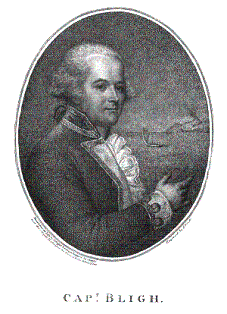
By
Captain William Bligh
Red and Black Publishers, St Petersburg,
Florida
First
published in London under the title A Voyage to the South Seas, 1792
Library of Congress Cataloging-in-Publication Data
Bligh, William,
1754-1817.
[Voyage to the South Sea]
The Bounty Mutiny : Captain William Bligh's firsthand
account of the
last voyage of HMS Bounty / by Captain William Bligh.
p. cm.
"First published in London under the title A
Voyage to the South Sea,
1792"--T.p. verso.
ISBN 978-1-934941-06-5
1. Bounty
(Ship) 2. Voyages and travels. 3.
Oceania--Description
and travel--Early works to 1800. 4. Bounty Mutiny, 1789. I.
Title.
DU21.B62 2008
910.4'5--dc22
2008001041
Red and Black
Publishers, PO Box 7542, St Petersburg, Florida, 33734
Contact us at: info@RedandBlackPublishers.com
Printed and manufactured in the United States
of America
Contents
Introduction 5
Chapter 1.
Plan
Of The Expedition
7
Chapter 2.
Departure
From England.
19
Chapter 3. Passage Towards The Cape Of Good Hope
39
Chapter 4. Passage Towards Van Diemen’s Land.
47
Chapter 5. Rocky Islands Discovered.
59
Chapter 6. Account Of An English Ship
65
Chapter 7. A Theft Committed. 83
Chapter 8. Expedition To Tettaba
93
Chapter 9. A Walk Into The Country.
105
Chapter 10. The
Ship’s Cable Cut In The Night.
123
Chapter 11. Arrival
Of An Arreoy Woman From Tethuroa.
135
Chapter 12. At
The Island Huaheine.
143
Chapter 13. A
Mutiny In The Ship.
153
Chapter 14. Proceed
In The Launch To The Island Tofoa.
161
Chapter 15. Passage
Towards New Holland.
173
Chapter 16. Progress
To The Northward
195
Chapter 17. Passage
From New Holland To The Island Timor.
213
Chapter 18. At
Coupang.
229
Chapter 19. From
Timor To Batavia.
235
Chapter 20. Occurrences At Batavia And Passage Thence To England.
243
Afterword 255
Introduction
by William Bligh
At
the time I published the Narrative of the Mutiny on Board the Bounty it
was my intention that the preceding part of the Voyage should be contained in a
separate account. This method I have since been induced to alter. The reason of
the Narrative appearing first was for the purpose of communicating early
information concerning an event which had attracted the public notice: and,
being drawn up in a hasty manner, it required many corrections. Some
circumstances likewise were omitted; and the notation of time used in the
Narrative being according to sea reckoning, in which the days begin and end at
noon, must have produced a degree of obscurity and confusion to readers
accustomed only to the civil mode. And this would have increased as the
remainder of the voyage, on account of the numerous shore occurrences at
Otaheite and elsewhere, could not, with clearness and propriety, have been
related in any other than the usual manner of reckoning.
Besides remedying these inconveniencies I have
thought a fuller account of our passage from Timor to Europe than that contained
in the Narrative would not be unacceptable. These reasons, with the manifest
convenience of comprising the whole Voyage in one continued narrative, in
preference to letting it appear in disjointed accounts will, it is hoped, be
allowed a sufficient excuse for having varied from the original intention.
Nevertheless for the accommodation of the purchasers of the Narrative already
published those who desire it will be supplied with the other parts of the
Voyage separate; i.e. the part previous to the mutiny and the additional account
after leaving Timor.
William Bligh, 1792
Chapter
1
Plan
of the Expedition. Outfit and Occurrences to the time of leaving England.
Description of the Breadfruit.
1787.
The King having been graciously pleased to comply with a request from the
merchants and planters interested in his Majesty’s West India possessions that
the breadfruit tree might be introduced into those islands, a vessel proper for
the undertaking was bought and taken into dock at Deptford to be provided with
the necessary fixtures and preparations for executing the object of the voyage.
These were completed according to a plan of my much honoured friend, Sir Joseph
Banks, which in the event proved the most advantageous that could have been
adopted for the intended purpose.
August 16.
The ship was named the Bounty: I was
appointed to command her on the 16th of August 1787. Her burthen was nearly two
hundred and fifteen tons; her extreme length on deck ninety feet ten inches;
extreme breadth twenty-four feet three inches; and height in the hold under the
beams at the main hatchway ten feet three inches. In the cockpit were the cabins
of the surgeon, gunner, botanist, and clerk, with a steward-room and storerooms.
The between decks was divided in the following manner: the great cabin was
appropriated for the preservation of the plants and extended as far forward as
the after hatchway. It had two large skylights, and on each side three scuttles
for air, and was fitted with a false floor cut full of holes to contain the
garden-pots in which the plants were to be brought home. The deck was covered
with lead, and at the foremost corners of the cabin were fixed pipes to carry
off the water that drained from the plants into tubs placed below to save it for
future use. I had a small cabin on one side to sleep in, adjoining to the great
cabin, and a place near the middle of the ship to eat in. The bulk-head of this
apartment was at the after-part of the main hatchway, and on each side of it
were the berths of the mates and midshipmen; between these berths the arm-chest
was placed. The cabin of the master, in which was always kept the key of the
arms, was opposite to mine. This particular description of the interior parts of
the ship is rendered necessary by the event of the expedition.
The ship was masted according to the
proportion of the navy; but on my application the masts were shortened, as I
thought them too much for her, considering the nature of the voyage.
September 3.
On the 3rd of September the ship came out of
dock; but the carpenters and joiners remained on board much longer, as they had
a great deal of work to finish.
The next material alteration made in the
fitting out was lessening the quantity of iron and other ballast. I gave
directions that only nineteen tons of iron should be taken on board instead of
the customary proportion which was forty-five tons. The stores and provisions I
judged would be fully sufficient to answer the purpose of the remainder; for I
am of opinion that many of the misfortunes which attend ships in heavy storms of
wind are occasioned by too much dead weight in their bottoms.
The establishment of men and officers for the
ship were as follows:
1 Lieutenant to command.
1 Master.
1 Boatswain.
1 Gunner.
1 Carpenter.
1 Surgeon.
2 Master’s Mates.
2 Midshipmen.
2 Quartermasters.
1 Quartermaster’s Mate.
1 Boatswain’s Mate.
1 Gunner’s Mate.
1 Carpenter’s Mate.
1 Carpenter’s Crew.
1 Sailmaker.
1 Armourer.
1 Corporal.
1 Clerk and Steward.
23 Able Seamen.
Total crew—44.
Two skilful and careful men were appointed, at
Sir Joseph Banks’s recommendation, to have the management of the plants
intended to be brought home: the one, David Nelson, who had been on similar
employment in Captain Cook’s last voyage; the other, William Brown, as an
assistant to him. With these two our whole number amounted to forty-six.
It was proposed that our route to the Society
Islands should be round Cape Horn; and the greatest dispatch became necessary as
the season was already far advanced: but the shipwrights not being able to
complete their work by the time the ship was ready in other respects, our
sailing was unavoidably retarded.
October. Thursday 4.
However by the 4th of October the pilot came
on board to take us down the river.
Tuesday 9.
On the 9th we fell down to Long Reach where we
received our gunner’s stores and guns, four four-pounders and ten swivels.
The ship was stored and victualled for
eighteen months. In addition to the customary allowance of provisions we were
supplied with sourkraut, portable soup, essence of malt, dried malt, and a
proportion of barley and wheat in lieu of oatmeal. I was likewise furnished with
a quantity of ironwork and trinkets to serve in our intercourse with the natives
in the South Seas: and from the board of Longitude I received a timekeeper, made
by Mr. Kendal.
Monday 15.
On the 15th I received orders to proceed to
Spithead.
November. Sunday 4.
But the winds and weather were so unfavourable
that we did not arrive there till the 4th of November. On the 24th I received
from Lord Hood, who commanded at Spithead, my final orders. The wind, which for
several days before had been favourable, was now turned directly against us.
Wednesday 28.
On the 28th the ship’s company received two
months pay in advance, and on the following morning we worked out to St.
Helen’s, where we were obliged to anchor.
1787. December. Sunday 23.
We made different unsuccessful attempts to get
down Channel, but contrary winds and bad weather constantly forced us back to
St. Helen’s, or Spithead, until Sunday the 23rd of December when we sailed
with a fair wind.
During our stay at Spithead, the rate of the
timepiece was several times examined by Mr. Bailey’s observations at the
Portsmouth observatory. On the 19th of December, the last time of its being
examined on shore, it was 1 minute 52 seconds, 5 too fast for meantime, and then
losing at the rate of 1 second, 1 per day; and at this rate I estimate its going
when we sailed.
The object of all the former voyages to the
South Seas undertaken by the command of his present majesty, has been the
advancement of science and the increase of knowledge. This voyage may be
reckoned the first the intention of which has been to derive benefit from those
distant discoveries. For the more fully comprehending the nature and plan of the
expedition, and that the reader may be possessed of every information necessary
for entering on the following sheets, I shall here lay before him a copy of the
instructions I received from the admiralty, and likewise a short description of
the breadfruit.
By The Commissioners For Executing The Office Of Lord High Admiral Of
Great Britain And Ireland, Etc.
Whereas the king, upon a representation from the merchants and planters
interested in his Majesty’s West India possessions that the introduction of
the breadfruit tree into the islands of those seas, to constitute an article of
food, would be of very essential benefit to the inhabitants, hath, in order to
promote the interests of so respectable a body of his subjects (especially in an
instance which promises general advantage) thought fit that measures should be
taken for the procuring some of those trees, and conveying them to the said West
India islands: And whereas the vessel under your command hath, in consequence
thereof, been stored and victualled for that service, and fitted with proper
conveniences and necessaries for the preservation of as many of the said trees
as, from her size, can be taken on board her; and you have been directed to
receive on board her the two gardeners named in the margin, David Nelson, and
William Brown, who, from their knowledge of trees and plants, have been hired
for the purpose of selecting such as shall appear to be of a proper species and
size:
You are, therefore, in pursuance of his majesty’s pleasure, signified
to us by Lord Sydney, one of his principal secretaries of state, hereby required
and directed to put to sea in the vessel you command, the first favourable
opportunity of wind and weather, and proceed with her, as expeditiously as
possible, round Cape Horn, to the Society Islands, situate in the Southern
ocean, in the latitude of about eighteen degrees south, and longitude of about
two hundred and ten degrees east from Greenwich, where, according to the
accounts given by the late Captain Cook, and persons who accompanied him during
his voyages, the breadfruit tree is to be found in the most luxuriant state.
Having arrived at the above-mentioned islands, and taken on board as
many trees and plants as may be thought necessary (the better to enable you to
do which, you have already been furnished with such articles of merchandise and
trinkets as it is supposed will be wanted to satisfy the natives) you are to
proceed from thence through Endeavour Straits (which separate New Holland from
New Guinea) to Prince’s Island in the Straits of Sunda, or, if it should
happen to be more convenient, to pass on the eastern side of Java to some port
on the north side of that island, where any breadfruit trees which may have been
injured, or have died, may be replaced by mangosteens, duriens, jacks, nancas,
lanfas, and other fine fruit trees of that quarter, as well as the rice plant
which grows upon dry land; all of which species (or such of them as shall be
judged most eligible) you are to purchase on the best terms you can from the
inhabitants of that island with the ducats with which you have also been
furnished for that purpose; taking care however, if the rice plants
above-mentioned cannot be procured at Java, to touch at Prince’s Island for
them, where they are regularly cultivated.
From Prince’s Island, or the Island of Java, you are to proceed round
the Cape of Good Hope to the West Indies (calling on your way thither at any
places which may be thought necessary) and deposit one half of such of the
above-mentioned trees and plants as may be then alive at his majesty’s
botanical garden at St. Vincent, for the benefit of the Windward Islands, and
then go on to Jamaica: and, having delivered the remainder to Mr. East, or such
person or persons as may be authorised by the governor and council of that
island to receive them, refreshed your people, and received on board such
provisions and stores as may be necessary for the voyage, make the best of your
way back to England; repairing to Spithead, and sending to our secretary an
account of your arrival and proceedings.
And whereas you will receive herewith a copy of the instructions which
have been given to the above-mentioned gardeners for their guidance, as well as
in procuring the said trees and plants, and the management of them after they
shall be put on board, as for bringing to England a small sample of each
species, and such others as may be prepared by the superintendent of the
botanical garden at St. Vincent’s, and by the said Mr. East, or others, for
his majesty’s garden at Kew; you are hereby required and directed to afford,
and to give directions to your officers and company to afford, the said
gardeners every possible aid and assistance, not only in the collecting of the
said trees and plants at the places before mentioned, but for their preservation
during their conveyance to the places of their destination.
Given under our hands the 20th November 1787.
Howe, Charles Brett, Rd. Hopkins, J. Leveson Gower.
To Lieutenant William Bligh, commanding his majesty’s armed vessel the
Bounty at Spithead.
By command of their Lordships,
P. Stephens.