Fireside
Chats of Franklin Delano Roosevelt
Radio Addresses to the American People
About the Depression, the New Deal, and The Second World War
1933-1944
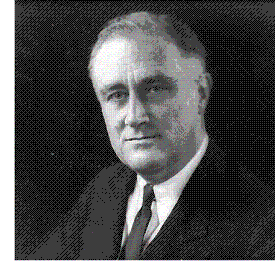
Franklin D Roosevelt
Red and Black Publishers, St Petersburg, Florida
Library
of Congress Cataloging-in-Publication Data
Roosevelt,
Franklin D. (Franklin Delano), 1882-1945.
Fireside chats of Franklin Delano Roosevelt : radio addresses
to the
American people about the Depression, the New Deal, and the Second
World
War, 1933-1944 / Franklin D Roosevelt.
p. cm.
ISBN 978-1-934941-20-1
1.
Roosevelt, Franklin D. (Franklin Delano),
1882-1945--Oratory--Sources.
2. Roosevelt, Franklin D.
(Franklin Delano), 1882- 1945--Political
and
social views--Sources. 3. United
States--Economic
conditions--
1918-1945--Sources 4. United
States--Economic policy--1933-1945--Sources.
5.
Depressions--1929--United States--Sources. 6.
New
Deal,
1933-1939--Sources.
7. World War, 1939-1945--United
States--Sources. 8. United
States--Politics
and government--1933-1945--Sources. 9. United
States--Foreign
relations--1933-1945--Sources. I.
Title.
E742.5.R65 2008
973.917092--dc22
2008013589
Red
and Black Publishers, PO Box 7542, St Petersburg, Florida,
33734
Contact
us at: info@RedandBlackPublishers.com
Printed and manufactured in the United States of America
Contents
March 12, 1933 5
May 7, 1933 11
July 24, 1933 21
October 22, 1933 31
June 28, 1934 39
September 30, 1934 47
April 28, 1935 57
September 6, 1936 67
March 9, 1937 77
October 12, 1937 89
November
14, 1937
99
April 14, 1938 105
June 24, 1939 119
September 3, 1939 129
May 26, 1940 133
December 29, 1940 145
May 27, 1941 157
September 11, 1941 171
December 9, 1941 181
February 23, 1942 191
April 28, 1942 203
September 7, 1942 215
October 12, 1942 225
May 2, 1943 235
July 28, 1943 243
September 8, 1943 255
December 24, 1943 261
June 5, 1944 271
June 23, 1944 277
March
12, 1933.
I
want to talk for a few minutes with the people of the United States about
banking—with the comparatively few who understand the mechanics of banking but
more particularly with the overwhelming majority who use banks for the making of
deposits and the drawing of checks. I want to tell you what has been done in the
last few days, why it was done, and what the next steps are going to be. I
recognize that the many proclamations from state capitols and from Washington,
the legislation, the treasury regulations, etc., couched for the most part in
banking and legal terms should be explained for the benefit of the average
citizen. I owe this in particular because of the fortitude and good temper with
which everybody has accepted the inconvenience and hardships of the banking
holiday. I know that when you understand what we in Washington have been about I
shall continue to have your cooperation as fully as I have had your sympathy and
help during the past week.
First of all let me state the simple fact that
when you deposit money in a bank the bank does not put the money into a safe
deposit vault. It invests your money in many different forms of credit—bonds,
commercial paper, mortgages and many other kinds of loans. In other words, the
bank puts your money to work to keep the wheels of industry and of agriculture
turning around. A comparatively small part of the money you put into the bank is
kept in currency—an amount which in normal times is wholly sufficient to cover
the cash needs of the average citizen. In other words, the total amount of all
the currency in the country is only a small fraction of the total deposits in
all of the banks.
What, then, happened during the last few days
of February and the first few days of March? Because of undermined confidence on
the part of the public, there was a general rush by a large portion of our
population to turn bank deposits into currency or gold—a rush so great that
the soundest banks could not get enough currency to meet the demand. The reason
for this was that on the spur of the moment it was, of course, impossible to
sell perfectly sound assets of a bank and convert them into cash except at panic
prices far below their real value.
By the afternoon of March 3d scarcely a bank
in the country was open to do business. Proclamations temporarily closing them
in whole or in part had been issued by the governors in almost all the states.
It was then that I issued the proclamation
providing for the nation-wide bank holiday, and this was the first step in the
government’s reconstruction of our financial and economic fabric.
The second step was the legislation promptly
and patriotically passed by the Congress confirming my proclamation and
broadening my powers so that it became possible in view of the requirement of
time to extend the holiday and lift the ban of that holiday gradually. This law
also gave authority to develop a program of rehabilitation of our banking
facilities. I want to tell our citizens in every part of the nation that the
national Congress—Republicans and Democrats alike—showed by this action a
devotion to public welfare and a realization of the emergency and the necessity
for speed that it is difficult to match in our history.
The third stage has been the series of
regulations permitting the banks to continue their functions to take care of the
distribution of food and household necessities and the payment of payrolls.
This bank holiday, while resulting in many
cases in great inconvenience, is affording us the opportunity to supply the
currency necessary to meet the situation. No sound bank is a dollar worse off
than it was when it closed its doors last Monday. Neither is any bank which may
turn out not to be in a position for immediate opening. The new law allows the
twelve Federal Reserve Banks to issue additional currency on good assets and
thus the banks which reopen will be able to meet every legitimate call. The new
currency is being sent out by the Bureau of Engraving and Printing in large
volume to every part of the country. It is sound currency because it is backed
by actual, good assets.
A question you will ask is this: why are all
the banks not to be reopened at the same time? The answer is simple. Your
government does not intend that the history of the past few years shall be
repeated. We do not want and will not have another epidemic of bank failures.
As a result, we start tomorrow, Monday, with
the opening of banks in the twelve Federal Reserve Bank cities—those banks
which on first examination by the treasury have already been found to be all
right. This will be followed on Tuesday by the resumption of all their functions
by banks already found to be sound in cities where there are recognized clearing
houses. That means about 250 cities of the United states.
On Wednesday and succeeding days banks in
smaller places all through the country will resume business, subject, of course,
to the government’s physical ability to complete its survey. It is necessary
that the reopening of banks be extended over a period in order to permit the
banks to make applications for necessary loans, to obtain currency needed to
meet their requirements and to enable the government to make common sense
checkups.
Let me make it clear to you that if your bank
does not open the first day you are by no means justified in believing that it
will not open. A bank that opens on one of the subsequent days is in exactly the
same status as the bank that opens tomorrow.
I know that many people are worrying about
state banks not members of the Federal Reserve System. These banks can and will
receive assistance from members banks and from the Reconstruction Finance
Corporation. These state banks are following the same course as the national
banks except that they get their licenses to resume business from the state
authorities, and these authorities have been asked by the Secretary of the
Treasury to permit their good banks to open up on the same schedule as the
national banks. I am confident that the state banking departments will be as
careful as the national government in the policy relating to the opening of
banks and will follow the same broad policy.
It is possible that when the banks resume a
very few people who have not recovered from their fear may again begin
withdrawals. Let me make it clear that the banks will take care of all
needs—and it is my belief that hoarding during the past week has become an
exceedingly unfashionable pastime. It needs no prophet to tell you that when the
people find that they can get their money—that they can get it when they want
it for all legitimate purposes—the phantom of fear will soon be laid. People
will again be glad to have their money where it will be safely taken care of and
where they can use it conveniently at any time. I can assure you that it is
safer to keep your money in a reopened bank than under the mattress.
The success of our whole great national
program depends, of course, upon the cooperation of the public—on its
intelligent support and use of a reliable system.
Remember that the essential accomplishment of
the new legislation is that it makes it possible for banks more readily to
convert their assets into cash than was the case before. More liberal provision
has been made for banks to borrow on these assets at the Reserve Banks and more
liberal provision has also been made for issuing currency on the security of
those good assets. This currency is not fiat currency. It is issued only on
adequate security—and every good bank has an abundance of such security.
One more point before I close. There will be,
of course, some banks unable to reopen without being reorganized. The new law
allows the government to assist in making these reorganizations quickly and
effectively and even allows the government to subscribe to at least a part of
new capital which may be required.
I hope you can see from this elemental recital
of what your government is doing that there is nothing complex, or radical, in
the process.
We had a bad banking situation. Some of our
bankers had shown themselves either incompetent or dishonest in their handling
of the people’s funds. They had used the money entrusted to them in
speculations and unwise loans. This was, of course, not true in the vast
majority of our banks, but it was true in enough of them to shock the people for
a time into a sense of insecurity and to put them into a frame of mind where
they did not differentiate, but seemed to assume that the acts of a comparative
few had tainted them all. It was the government’s job to straighten out this
situation and do it as quickly as possible—and the job is being performed.
I do not promise you that every bank will be
reopened or that individual losses will not be suffered, but there will be no
losses that possibly could be avoided; and there would have been more and
greater losses had we continued to drift. I can even promise you salvation for
some at least of the sorely pressed banks. We shall be engaged not merely in
reopening sound banks but in the creation of sound banks through reorganization.
It has been wonderful to me to catch the note
of confidence from all over the country. I can never be sufficiently grateful to
the people for the loyal support they have given me in their acceptance of the
judgment that has dictated our course, even though all our processes may not
have seemed clear to them.
After all, there is an element in the
readjustment of our financial system more important than currency, more
important than gold, and that is the confidence of the people. Confidence and
courage are the essentials of success in carrying out our plan. You people must
have faith; you must not be stampeded by rumors or guesses. Let us unite in
banishing fear. We have provided the machinery to restore our financial system;
it is up to you to support and make it work.
It is your problem no less than it is mine.
Together we cannot fail.