The Gateless Gate
A Collection of Zen Koan
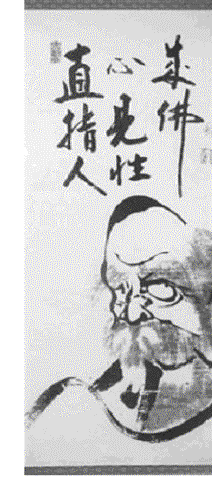
by Mumon
translated by Nyogen Senzaki and Paul Reps
Red and Black Publishers, St Petersburg, Florida
The Gateless Gate
This translation first published 1934
Library of Congress Cataloging-in-Publication Data
Huikai,
1183-1260.
[Wumen guan. English]
The gateless gate : a collection of Zen koan / by Mumon ; translated
by Nyogen Senzaki and Paul Reps.
p. cm.
"This translation first published 1934"--T.P. verso.
ISBN 978-1-934941-18-8
1. Koan--Early works to
1800. I. Senzaki, Nyogen. II.
Reps, Paul,
1895-1990. III. Title.
BQ9289.H8413 2008
294.3'443--dc22
2008013587
Red
and Black Publishers, PO Box 7542, St Petersburg, Florida,
33734
Contact
us at: info@RedandBlackPublishers.com
Printed
and manufactured in the United States of America
The Gateless Gate
1. Joshu’s Dog
A
monk asked Joshu, a Chinese Zen master: “Has a dog Buddha-nature or no?”
Joshu answered: “Mu.” [Mu is the
negative symbol in Chinese, meaning “No thing” or “Not.”]
Mumon’s
comment: To
realize Zen one has to pass through the barrier of the patriarchs. Enlightenment
always comes after the road of thinking is blocked. If you do not pass the
barrier of the patriarchs or if your thinking road is not blocked, whatever you
think, whatever you do, is like a tangling ghost. You may ask: What is a barrier
of a patriarch? This one word, Mu, is it.
This
is the barrier of Zen. If you pass through it you will see Joshu face to face.
Then you can work hand in hand with the whole line of patriarchs. Is this not a
pleasant thing to do?
If
you want to pass this barrier, you must work through every bone in your body,
through every pore of your skin, filled with this question: What is Mu?
and carry it day and night. Do not believe it is the common negative symbol
meaning nothing. It is not nothingness, the opposite of existence. If you really
want to pass this barrier, you should feel like drinking a hot iron ball that
you can neither swallow nor spit out.
Then your previous lesser knowledge disappears. As
a fruit ripening in season, your subjectivity and objectivity naturally become
one. It is like a dumb man who has had a dream. He knows about it but he cannot
tell it.
When
he enters this condition his ego-shell is crushed and he can shake the heaven
and move the earth. He is like a great warrior with a sharp sword. If a Buddha
stands in his way, he will cut him down; if a patriarch offers him any obstacle,
he will kill him; and he will be free in his way of birth and death. He can
enter any world as if it were his own playground. I will tell you how to do this
with this koan:
Just
concentrate your whole energy into this Mu, and do not allow any
discontinuation. When you enter this Mu and there is no discontinuation,
your attainment will be as a candle burning and illuminating the whole universe.
Has a dog Buddha-nature?
This is the most
serious question of all.
If you say yes or
no,
You lose your own
Buddha-nature.
2. Hyakujo’s Fox
Once
when Hyakujo delivered some Zen lectures an old man attended them, unseen by the
monks. At the end of each talk when the monks left so did he. But one day he
remained after they had gone, and Hyakujo asked him: “Who are you?”
The
old man replied: “I am not a human being, but I was a human being when the
Kashapa Buddha preached in this world. I was a Zen master and lived on this
mountain. At that time one of my students asked me whether or not the
enlightened man is subject to the law of causation. I answered him: ‘The
enlightened man is not subject to the law of causation.’ For this answer
evidencing a clinging to absoluteness I became a fox for five hundred rebirths,
and I am still a fox. Will you save me from this condition with your Zen words
and let me get out of a fox’s body? Now may I ask you: Is the enlightened man
subject to the law of causation?”
Hyakujo
said: “The enlightened man is one with the law of causation.”
At
the words of Hyakujo the old man was enlightened. “I am emancipated,” he
said, paying homage with a deep bow. “I am no more a fox, but I have to leave
my body in my dwelling place behind this mountain. Please perform my funeral as
a monk.” Then he disappeared.
The
next day Hyakujo gave an order through the chief monk to prepare to attend the
funeral of a monk. “No one was sick in the infirmary,” wondered the monks.
“What does our teacher mean?”
After
dinner Hyakujo led the monks out and around the mountain. In a cave, with his
staff he poked out the corpse of an old fox and then performed the ceremony of
cremation.
That
evening Hyakujo gave a talk to the monks and told them this story about the law
of causation.
Obaku,
upon hearing the story, asked Hyakujo: “I understand that a long time ago
because a certain person gave a wrong Zen answer he became a fox for five
hundred rebirths. Now I want to ask: If some modern master is asked many
questions and he always gives the right answer, what will become of him?”
Hyakujo
said: “You come here near me and I will tell you.”
Obaku
went near Hyakujo and slapped the teacher’s face with his hand, for he knew
this was the answer his teacher intended to give him.
Hyakujo clapped his hands and laughed at this
discernment. “I thought a Persian had a red beard,” he said, “and now I
know a Persian who has a red beard.”
Mumon’s
comment:
“The enlightened man is not subject.” How can this answer make the monk a
fox?
“The enlightened man is one with the law of
causation.” How can this answer make the fox emancipated?
To
understand this clearly one has to have just one eye.
Controlled or not
controlled?
The same dice
shows two faces.
Not controlled or
controlled,
Both are a
grievous error.