History
of the American Expedition Fighting the Bolsheviks
US
Military Intervention in Soviet Russia 1918-1919
by Capt. Joel
R Moore, Lt. Harry H Meade, and
Lt Lewis E Jahns
Red
and Black Publishers, St Petersburg, Florida
First
published in Detroit in 1920.
Cover
illustration: White Russian
propaganda poster depicting Trotsky, with Star of David, as the Devil.
Library of Congress
Cataloging-in-Publication Data
Moore, Joel R.
(Joel Roscoe), b. 1879.
History of the American
expedition fighting the Bolsheviks : U.S.
military intervention in Soviet Russia 1918-1919 / by
Joel R. Moore, Harry
H. Meade, and Lewis E. Jahns.
p. cm.
ISBN 978-1-934941-22-5
1. Soviet
Union--History--Allied intervention, 1918-1920. 2.
Soviet
Union--History--Revolution, 1917-1921--Personal
narratives, American.
3. Soviet
Union--History--Revolution, 1917-1921--Participation,
American. 4. Soldiers--United
States--Biography. I. Meade,
Harry H. II.
Jahns, Lewis E. III. Title. IV. Title: U.S. military
intervention in Soviet
Russia 1918-1919.
DK265.42.U5M67 2008
947.084'1--dc22
2008013591
Red
and Black Publishers, PO Box 7542, St Petersburg, Florida,
33734
Contact
us at: info@RedandBlackPublishers.com
Printed
and manufactured in the United States of America
Table
of Contents
Introduction
9
U.
S. A. Medical Units on the Arctic Ocean
13
Fall
Offensive on the Railroad
19
River
Push for Kotlas
33
Doughboys
on Guard in Archangel
41
Why
American Troops Were Sent to Russia
49
On
the Famous Kodish Front in the Fall
59
Penetrating
to Ust Padenga
69
Peasantry
of the Archangel Province
77
“H”
Company Pushes Up the Onega Valley
89
“G”
Company Far Up the Pinega River
95
With
Wounded and Sick
99
Armistice
Day with Americans in North Russia
113
Winter
Defense of Toulgas
117
Great
White Reaches
127
Mournful
Kodish
139
Ust
Padenga
149
The
Retreat from Shenkursk
155
Defense
of Pinega
165
The
Land and the People
195
Holding
the Onega Valley
207
Ice-Bound
Archangel
215
Winter
on the Railroad
225
Bolsheozerki
231
Letting
Go the Tail-Holt 237
“Come
Get Your Pills”
251
Signal
Platoon Wins Commendation
257
The
Doughboy’s Money in Archangel
261
Propaganda
and Propaganda and—
267
Real
Facts about Alleged Mutiny
275
Our
Allies, French, British and Russian
285
Felchers,
Priests and Icons
299
Bolshevism
305
Y.M.C.A.
and Y.W.C.A. with Troops
315
“Dobra”
Convalescent Hospital
325
Captive
Doughboys in Bolshevikdom
337
Military
Decorations
347
Homeward
Bound
349
Preface
To Our Comrades
and Friends
To our comrades
and friends we address these prefatory words. The book is about to go to the
printers and binders. Constantly while writing the historical account of the
American expedition, which fought the Bolsheviki in North Russia, we have had
our comrades in mind. You are the ones most interested in getting a complete
historical account. It is a wonderful story of your own fighting and hardships,
of your own fortitude and valor. It is a story that will make the eyes of the
home folks shine with pride.
Probably
you never could have known how remarkably good is the record of your outfits in
that strange campaign if you had not commissioned three of your comrades to
write the book for you. In the national army, we happened to be officers; in
civil life we are respectively, college professor, lawyer, and public
accountant, in the order in which our names appear on the title page. But we
prefer to come to you now with the finished product merely as comrades who
request you to take the book at its actual value to you—a faithful description
of our part in the great world war. We are proud of the record the Americans
made in the expedition.
We
think that nothing of importance has been omitted. Some sources of information
were not open to us—will be to no one for years. But from some copies of
official reports, from company and individual diaries, and from special
contributions written for us, we have been able to write a complete narrative of
the expedition. In all cases except a few where the modesty of the writer
impelled him to ask us not to mention his name, we have referred to individuals
who have contributed to the book. To these contributors all, we here make
acknowledgment of our debt to them for their cordial co-operation. For the
wealth of photo-engravures which the book carries, we have given acknowledgment
along with each individual engraving, for furnishing us with the photographic
views of the war scenes and folk scenes of North Russia. Most of them are, of
course, from the official United States Signal Corps war pictures.
When
we started the book, we had no idea that it would develop into the big book it
is, a de luxe edition, of fine materials and fine workmanship. We have not been
able to risk a large edition. Only two thousand copies are being printed. They
are made especially for the boys who were up there under the Arctic Circle, made
as nice as we could get them made. Of many of the comrades we have lost track,
but we trust that somehow they will hear of this book and become one of the
proud possessors of a copy. To our comrades and friends, we offer this volume
with the expectation that you will be pleased with it and that after you have
read it, you will glow with pride when you pass it over to a relative or friend
to read.
Detroit,
Michigan, September, 1920
Joel
R. Moore, Harry H. Mead, Lewis E. Jahns
Introduction
The troopships Somali,
Tydeus, and Nagoya rubbed the Bakaritza and Smolny quays sullenly
and listed heavily to port. The American doughboys grimly marched down the
gangplanks and set their feet on the soil of Russia, September 5th, 1918. The
dark waters of the Dvina River were beaten into fury by the opposing north wind
and ocean tide. And the lowering clouds of the Arctic sky added their dismal bit
to this introduction to the dreadful conflict which these American sons of
liberty were to wage with the Bolsheviki during the year’s campaign.
In
the rainy fall season by their dash and valor they were to expel the Red Guards
from the cities and villages of the state of Archangel, pursuing the enemy
vigorously up the Dvina, the Vaga, the Onega and the Pinega Rivers, and up the
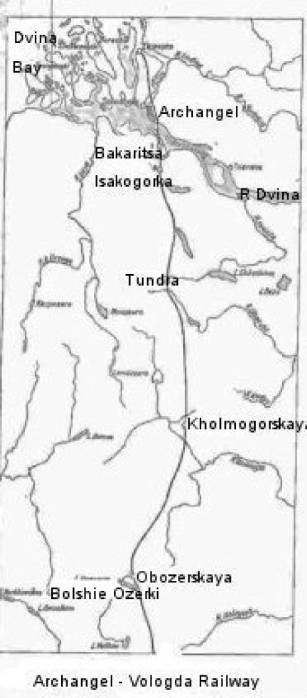
Archangel-Vologda Railway and the Kodish-Plesetskaya-Petrograd state highway.
They were to plant their entrenched outposts in a great irregular horseshoe
line, one cork at Chekuevo, the toe at Ust-Padenga, the other cork of the shoe
at Karpagorskaya. They were to run out from the city of Archangel long, long
lines of communication, spread wide like the fingers of a great hand that sought
seemingly to cover as much of North Russia as possible with Allied military
protection.
In
the winter, in the long, long nights and black, howling forests and frozen
trenches, with ever-deepening snows and sinking thermometer, with the rivers and
the White Sea and the Arctic Ocean solid ice fifteen feet thick, these same
soldiers now seen disembarking from the troopships, were to find their enemy
greatly increasing his forces every month at all points on the Allied line.
Stern defense everywhere on that far-flung trench and blockhouse and
fortified-village battle line. They were to feel the overwhelming pressure of
superior artillery and superior equipment and transportation controlled by the
enemy and especially the crushing odds of four to ten times the number of men on
the battle lines. And with it they were to feel the dogged sense of the grim
necessity of fighting for every verst [a Russian verst is about
two-thirds of a mile] of frozen ground. Their very lives were to depend upon the
stubbornness of their holding retreat. There could be no retreating beyond
Archangel, for the ships were frozen in the harbor. Indeed a retreat to the city
of Archangel itself was dangerous. It might lead to revulsion of temper among
the populace and enable the Red Guards to secure aid from within the lines so as
to carry out Trotsky’s threat of pushing the foreign bayonets all under the
ice of the White Sea. And in that remarkable winter defense these American
soldiers were to make history for American arms, exhibiting courage and
fortitude and heroism, the stories of which are to embellish the annals of
American martial exploits. They were destined, a handful of them here, a handful
there, to successfully baffle the Bolshevik hordes in their savage drives.
In
the spring the great ice crunching up in the rivers and the sea was to behold
those same veteran Yanks still fighting the Red Guard armies and doing their bit
to keep the state of Archangel, the North Russian Republic, safe, and their own
skins whole. The warming sun and bursting green were to see the olive-drab
uniform, tattered and torn as it was, covering a wearied and hungry and homesick
but nevertheless fearless and valiant American soldier. With deadly effect they
were to meet the onrushing swarms of Bolos on all fronts and slaughter them on
their wire with rifle and machine gun fire and smash up their reserves with
artillery fire. With desperation they were to dispute the overwhelming columns
of infantry who were hurled by no less a renowned old Russian General than
Kuropatkin, and at Malo Bereznik and Bolsheozerki, in particular, to send them
reeling back in bloody disaster. They were to fight the Bolshevik to a
standstill so that they could make their guarded getaway.
Summer
was to see these Americans at last handing over the defenses to Russian Northern
Republic soldiers who had been trained during the winter at Archangel and
gradually during the spring broken in for duty alongside the American and
British troops and later were to hold the lines in some places by themselves and
in others to share the lines with the new British troops coming in twenty
thousand strong “to finish the bloody show.” Gaily decorated Archangel was
to bid the Americanski dasvedanhnia and God-speed in June. Blue rippling waters
were to meet the ocean-bound prows. Music from the cruiser Des Moines
(come to see us out) was to blow fainter and fainter in the distance as they
cheered us out of the Dvina River for home.
Now
the troops are hurrying off the transport. They are just facing the strange,
terrible campaign faintly outlined. It is now our duty to faithfully tell the
detailed story of it—“The History of the American North Russian
Expedition,” to try to do justice in this short volume to the gripping story
of the American soldiers “Campaigning in North Russia, 1918-1919.”
The
American North Russian Expeditionary Force consisted of the 339th Infantry,
which had been known at Camp Custer as “Detroit’s Own,” one battalion of
the 310th Engineers, the 337th Ambulance Company, and the 337th Field Hospital
Company. The force was under the command of Col. George E. Stewart, 339th
Infantry, who was a veteran of the Philippines and of Alaska. The force numbered
in all, with the replacements who came later, about five thousand five hundred
men.
These
units had been detached from the 85th Division, the Custer Division, while it
was enroute to France, and had been assembled in southern England, there
re-outfitted for the climate and warfare of the North of Russia. On August the
25th, the American forces embarked at Newcastle-on-Tyne in three British
troopships, the Somali, the Tydeus and the Nagoya and set
sail for Archangel, Russia. A fourth transport, the Czar, carried Italian
troops who travelled as far as the Murmansk with our convoy.
The voyage up the North Sea and across the Arctic
Ocean, zig-zagging day and night for fear of the submarines, rounding the North
Cape far toward the pole where the summer sun at midnight scarcely set below the
northwestern horizon, was uneventful save for the occasional alarm of a floating
mine and for the dreadful outbreak of Spanish “flu” on board the ships. On
board one of the ships the supply of yeast ran out and breadless days stared the
soldiers in the face till a resourceful army cook cudgelled up recollections of
seeing his mother use drainings from the potato kettle in making her bread. Then
he put the lightening once more into the dough. And the boys will remember also
the frigid breezes of the Arctic that made them wish for their overcoats which
by order had been packed in their barrack bags, stowed deep down in the hold of
the ships. And this suffering from the cold as they crossed the Arctic circle
was a foretaste of what they were to be up against in the long months to come in
North Russia.
We
had thought to touch the Murmansk coast on our way to Archangel, but as we
zig-zagged through the white-capped Arctic waves we picked up a wireless from
the authorities in command at Archangel which ordered the American troopships to
hasten on at full speed. The handful of American sailors from the Olympia,
the crippled category men from England and the little battalion of French
troops, which had boldly driven the Red Guards from Archangel and pursued them
up the Dvina and up the Archangel-Vologda Railway, were threatened with
extermination. The Reds had gathered forces and turned savagely upon them.
So
we sped up into the White Sea and into the winding channels of the broad Dvina.
For miles and miles we passed along the shores dotted with fishing villages and
with great lumber camps. The distant domes of the cathedrals in Archangel came
nearer and nearer. At last the water front of that great lumber port of old
Peter the Great lay before us strange and picturesque. We dropped anchor at
10:00 a.m. on the fourth day of September, 1918. The anchor chains ran out with
a cautious rattle. We swung on the swift current of the Dvina, studied the
shoreline and the skyline of the city of Archangel, saw the Allied cruisers,
bulldogs of the sea, and turned our eyes southward toward the boundless pine
forest where our American and Allied forces were somewhere beset by the
Bolsheviki, or we turned our eyes northward and westward whence we had come and
wondered what the folks back home would say to hear of our fighting in North
Russia.