Recollections
and Letters of General Robert E. Lee
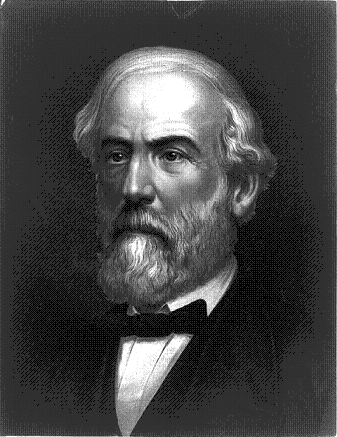
by
Captain Robert E. Lee, His Son
Red
and Black Publishers, St Petersburg, Florida
Originally published 1904
Library of Congress Cataloging-in-Publication Data
Lee, Robert E.
(Robert Edward), 1843-1914.
Recollections and letters of General Robert E. Lee / by
Captain
Robert E. Lee, his son.
p. cm.
Originally published: New
York : Doubleday, Page
& Co., 1904.
ISBN 978-1-934941-13-3
1. Lee, Robert E.
(Robert Edward), 1807-1870. 2. Lee,
Robert E.
(Robert Edward), 1807-1870--Correspondence. 3.
Generals--United
States--Biography. 4. Generals--Confederate
States of America--Biography. 5.
Confederate States of America. Army--Biography. 6.
Lee, Robert E.
(Robert Edward), 1843-1914. 7.
Lee family. I. Lee, Robert
E. (Robert
Edward), 1807-1870. II. Title.
E467.1.L4L43 2008
973.7'3092--dc22
[B]
2008009881
Red
and Black Publishers, PO Box 7542, St Petersburg, Florida,
33734
Contact
us at: info@RedandBlackPublishers.com
Printed
and manufactured in the United States of America
Contents
Chapter I
Services in the United States Army 5
Chapter II
The Confederate General
19
Chapter III
Letters to Wife and Daughters
39
Chapter IV
Army Life of Robert the Younger 57
Chapter V
The Army of Northern Virginia
73
Chapter VI
The Winter of 1863-4
89
Chapter VII
Fronting the Army of the Potomac 101
Chapter VIII
The Surrender
113
Chapter IX
A Private Citizen 125
Chapter X
President of Washington College
139
Chapter XI
The Idol of the South
153
Chapter XII
Lee’s Opinion upon the Late War
169
Chapter XIII
Family Affairs
193
Chapter XIV
An Ideal Father
207
Chapter XV
Mountain Rides
217
Chapter XVI
An Advisor of Young Men
229
Chapter XVII
The Reconstruction Period
243
Chapter XVIII
Mrs. R. E. Lee
259
Chapter XIX
Lee’s Letters to His Sons
275
Chapter XX
The New Home in Lexington
289
Chapter XXI
Failing Health
303
Chapter XXII
The Southern Trip
313
Chapter XXIII
A Round of Visits
333
Chapter XXIV
Last Days
349
Chapter
I
Services
in the United States Army
Captain
Lee, of the Engineers, a hero to his child—The family pets—Home from the
Mexican War—Three years in Baltimore—Superintendent of the West Point
Military Academy—Lieutenant-Colonel of Second Cavalry—Supresses “John
Brown Raid” at Harper’s Ferry—Commands the Department of Taxes
The
first vivid recollection I have of my father is his arrival at Arlington, after
his return from the Mexican War. I can remember some events of which he seemed a
part, when we lived at Fort Hamilton, New York, about 1846, but they are more
like dreams, very indistinct and disconnected—naturally so, for I was at that
time about three years old. But the day of his return to Arlington, after an
absence of more than two years, I have always remembered. I had a frock or
blouse of some light wash material, probably cotton, a blue ground dotted over
with white diamond figures. Of this I was very proud, and wanted to wear it on
this important occasion. Eliza, my “mammy,” objecting, we had a contest and
I won. Clothed in this, my very best, and with my hair freshly curled in long
golden ringlets, I went down into the larger hall where the whole household was
assembled, eagerly greeting my father, who had just arrived on horseback from
Washington, having missed in some way the carriage which had been sent for him.
There was visiting us at this time Mrs. Lippitt, a
friend of my mother’s, with her little boy, Armistead, about my age and size,
also with long curls. Whether he wore as handsome a suit as mine I cannot
remember, but he and I were left together in the background, feeling rather
frightened and awed. After a moment’s greeting to those surrounding him, my
father pushed through the crowd, exclaiming:
“Where is my little boy?”
He then took up in his arms and kissed—not me, his
own child in his best frock with clean face and well-arranged curls—but my
little playmate, Armistead! I remember nothing more of any circumstances
connected with that time, save that I was shocked and humiliated. I have no
doubt that he was at once informed of his mistake and made ample amends to me.
A letter from my father to his brother Captain S. S.
Lee, United States Navy, dated “Arlington, June 30, 1848,” tells of his
coming home:
“Here I am once again, my dear Smith, perfectly
surrounded by Mary and her precious children, who seem to devote themselves to
staring at the furrows in my face and the white hairs in my head. It is not
surprising that I am hardly recognisable to some of the young eyes around me and
perfectly unknown to the youngest. But some of the older ones gaze with
astonishment and wonder at me, and seem at a loss to reconcile what they see and
what was pictured in their imaginations. I find them, too, much grown, and all
well, and I have much cause for thankfulness, and gratitude to that good God who
has once more united us.”
My next recollection of my father is in Baltimore,
while we were on a visit to his sister, Mrs. Marshall, the wife of Judge
Marshall. I remember being down on the wharves, where my father had taken me to
see the landing of a mustang pony which he had gotten for me in Mexico, and
which had been shipped from Vera Cruz to Baltimore in a sailing vessel. I was
all eyes for the pony, and a very miserable, sad-looking object he was. From his
long voyage, cramped quarters and unavoidable lack of grooming, he was rather a
disappointment to me, but I soon got over all that. As I grew older, and was
able to ride and appreciate him, he became the joy and pride of my life. I was
taught to ride on him by Jim Connally, the faithful Irish servant of my father,
who had been with him in Mexico. Jim used to tell me, in his quizzical way, that
he and “Santa Anna” (the pony’s name) were the first men on the walls of
Chepultepec. This pony was pure white, five years old and about fourteen hands
high. For his inches, he was as good a horse as I ever have seen. While we lived
in Baltimore, he and “Grace Darling,” my father’s favourite mare, were
members of our family.
Grace Darling was a chestnut of fine size and of
great power, which he had bought in Texas on his way out to Mexico, her owner
having died on the march out. She was with him during the entire campaign, and
was shot seven times; at least, as a little fellow I used to brag about that
number of bullets being in her, and since I could point out the scars of each
one, I presume it was so. My father was very much attached to her and proud of
her, always petting her and talking to her in a loving way, when he rode her or
went to see her in her stall. Of her he wrote on his return home:
“I only arrived yesterday, after a long journey up the
Mississippi, which route I was induced to take, for the better accommodation of
my horse, as I wished to spare her as much annoyance and fatigue as possible,
she already having undergone so much suffering in my service. I landed her at
Wheeling and left her to come over with Jim.”
Santa Anna was found lying cold and dead in the park
at Arlington one morning in the winter of ‘60-‘61. Grace Darling was taken
in the spring of ‘62 from the White House [my brother’s place on the
Pamunkey River, where the mare had been sent for save keeping] by some Federal
quartermaster, when McClellan occupied that place as his base of supplies during
his attack on Richmond. When we lived in Baltimore, I was greatly struck one day
by hearing two ladies who were visiting us saying: “Everybody and
everything—his family, his friends, his horse, and his dog—loves Colonel
Lee.”
The dog referred to was a black-and-tan terrier named
“Spec,” very bright and intelligent and really a member of the family,
respected and beloved by ourselves and well known to all who knew us. My father
picked up his mother in the “Narrows” while crossing from Fort Hamilton to
the fortifications opposite on Staten Island. She had doubtless fallen overboard
from some passing vessel and had drifted out of sight before her absence had
been discovered. He rescued her and took her home, where she was welcomed by his
children and made much of. She was a handsome little thing, with cropped ears
and a short tail. My father named her “Dart.” She was a fine ratter, and
with the assistance of a Maltese cat, also a member of the family, the many rats
which infested the house and stables were driven away or destroyed. She and the
cat were fed out of the same plate, but Dart was not allowed to begin the meal
until the cat had finished.
Spec was born at Fort Hamilton and was the joy of us
children, our pet and companion. My father would not allow his tail and ears to
be cropped. When he grew up, he accompanied us everywhere and was in the habit
of going into church with the family. As some of the little ones allowed their
devotions to be disturbed by Spec’s presence, my father determined to leave
him at home on those occasions. So the next Sunday morning, he was sent up to
the front room of the second story. After the family had left for church he
contented himself for awhile looking out of the window, which was open, it being
summer time. Presently impatience overcame his judgement and he jumped to the
ground, landed safely notwithstanding the distance, joined the family just as
they reached the church, and went in with them as usual, much to the joy of the
children. After that he was allowed to go to church whenever he wished. My
father was very fond of him, and loved to talk to him and about him as if he
were really one of us. In a letter to my mother, dated Fort Hamilton, January
18, 1846, when she and her children were on a visit to Arlington, he thus speaks
of him:
“...I am very solitary, and my only company is my dogs
and cats. But ‘Spec’ has become so jealous now that he will hardly let me
look at the cats. He seems to be afraid that I am going off from him, and never
lets me stir without him. Lies down in the office from eight to four without
moving, and turns himself before the fire as the side from it becomes cold. I
catch him sometimes sitting up looking at me so intently that I am for a moment
startled...”
In a letter from Mexico written a year
later—December 25, ‘46, to my mother, he says:
“...Can’t you cure poor ‘Spec.’ Cheer him
up—take him to walk with you and tell the children to cheer him up...”
In another letter from Mexico to his eldest boy, just
after the capture of Vera Cruz, he sends this message to Spec....
“Tell him I wish he was here with me. He would have
been of great service in telling me when I was coming upon the Mexicans. When I
was reconnoitering around Vera Cruz, their dogs frequently told me by barking
when I was approaching them too nearly....”
When he returned to Arlington from Mexico, Spec was
the first to recognise him, and the extravagance of his demonstrations of
delight left no doubt that he knew at once his kind master and loving friend,
though he had been absent three years. Sometime during our residence in
Baltimore, Spec disappeared, and we never knew his fate.
From that early time I began to be impressed with my
father’s character, as compared with other men. Every member of the household
respected, revered and loved him as a matter of course, but it began to dawn on
me that every one else with whom I was thrown held him high in their regard. At
forty-five years of age he was active, strong, and as handsome as he had ever
been. I never remember his being ill. I presume he was indisposed at times; but
no impressions of that kind remain. He was always bright and gay with us little
folk, romping, playing, and joking with us. With the older children, he was just
as companionable, and they have seen him join my elder brothers and their
friends when they would try their powers at a high jump put up in our yard. The
two younger children he petted a great deal, and our greatest treat was to get
into his bed in the morning and lie close to him, listening while he talked to
us in his bright, entertaining way. This custom we kept up until I was ten years
old and over. Although he was so joyous and familiar with us, he was very firm
on all proper occasions, never indulged us in anything that was not good for us,
and exacted the most implicit obedience. I always knew that it was impossible to
disobey my father. I felt it in me, I never thought why, but was perfectly sure
when he gave an order that it had to be obeyed. My mother I could sometimes
circumvent, and at times took liberties with her orders, construing them to suit
myself; but exact obedience to every mandate of my father was part of my life
and being at that time. He was very fond of having his hands tickled, and, what
was still more curious, it pleased and delighted him to take off his slippers
and place his feet in our laps in order to have them tickled. Often, as little
things, after romping all day, the enforced sitting would be too much for us,
and our drowsiness would soon show itself in continued nods. Then, to arouse,
us, he had a way of stirring us up with his foot—laughing heartily at and with
us. He would often tell us the most delightful stories, and then there was no
nodding. Sometimes, however, our interest in his wonderful tales became so
engrossing that we would forget to do our duty—when he would declare, “No
tickling, no story!” When we were a little older, our elder sister told us one
winter the ever-delightful “Lady of the Lake.” Of course, she told it in
prose and arranged it to suit our mental capacity. Our father was generally in
his corner by the fire, most probably with a foot in either the lap of myself or
youngest sister—the tickling going on briskly—and would come in at different
points of the tale and repeat line after line of the poem—much to our
disapproval—but to his great enjoyment.
In January, 1849, Captain Lee was one of a board of
army officers appointed to examine the coasts of Florida and its defenses and to
recommend locations for new fortifications. In April he was assigned to the duty
of the construction of Fort Carroll, in the Patapsco River below Baltimore. He
was there, I think, for three years, and lived in a house on Madison Street,
three doors above Biddle. I used to go down with him to the Fort quite often. We
went to the wharf in a “bus,” and there we were met by a boat with two
oarsmen, who rowed us down to Sollers Point, where I was generally left under
the care of the people who lived there, while my father went over to the Fort, a
short distance out in the river. These days were happy ones for me. The wharves,
the shipping, the river, the boat and oarsmen, and the country dinner we had at
the house at Sollers Point, all made a strong impression on me; but above all I
remember my father, his gentle, loving care of me, his bright talk, his stories,
his maxims and teachings. I was very proud of him and of the evident respect for
and trust in him every one showed. These impressions, obtained at that time,
have never left me. He was a great favourite in Baltimore, as he was everywhere,
especially with ladies and little children. When he and my mother went out in
the evening to some entertainment, we were often allowed to sit up and see them
off; my father, as I remember, always in full uniform, always ready and waiting
for my mother, who was generally late. He would chide her gently, in a playful
way and with a bright smile. He would then bid us good- bye, and I would go to
sleep with this beautiful picture in my mind, the golden epaulets and
all—chiefly the epaulets.
In Baltimore, I went to my first school, that of a
Mr. Rollins on Mulberry Street, and I remember how interested my father was in
my studies, my failures, and my little triumphs. Indeed, he was so always, as
long as I was at school and college, and I only wish that all of the kind,
sensible, useful letters he wrote me had been preserved.
My memory as to the move from Baltimore, which
occurred in 1852, is very dim. I think the family went to Arlington to remain
until my father had arranged for our removal to the new home at West Point.
My recollection of my father as Superintendent of the
West Point Military Academy is much more distinct. He lived in the house which
is still occupied by the Superintendent. It was built of stone, large and roomy,
with gardens, stables, and pasture lots. We, the two youngest children, enjoyed
it all. “Grace Darling” and “Santa Anna” were there with us, and many a
fine ride did I have with my father in the afternoons, when, released from his
office, he would mount his old mare and, with Santa Anna carrying me by his
side, take a five or ten-mile trot. Though the pony cantered delightfully, he
would make me keep him in a trot, saying playfully that the hammering sustained
was good for me. We rode the dragoon-seat, no posting, and until I became
accustomed to it I used to be very tired by the time I got back.
My father was the most punctual man I ever knew. He
was always ready for family prayers, for meals, and met every engagement, social
or business, at the moment. He expected all of us to be the same, and taught us
the use and necessity of forming such habits for the convenience of all
concerned. I never knew him late for Sunday service at the Post Chapel. He used
to appear some minutes before the rest of us, in uniform, jokingly rallying my
mother for being late, and for forgetting something at the last moment. When he
could wait no longer for her, he would say that he was off and would march along
to church by himself, or with any of the children who were ready. There he sat
very straight—well up the middle aisle—and, as I remember, always became
very sleepy, and sometimes even took a little nap during the sermon. At that
time, this drowsiness of my father’s was something awful to me, inexplicable.
I know it was very hard for me to keep awake, and frequently I did not; but why
he, who to my mind could do everything right, without any effort, should
sometimes be overcome, I could not understand, and did not try to do so.
It was against the rules that the cadets should go
beyond certain limits without permission. Of course they did go sometimes, and
when caught were given quite a number of “demerits.” My father was riding
out one afternoon with me, and, while rounding a turn in the mountain road with
a deep woody ravine on one side, we came suddenly upon three cadets far beyond
the limits. They immediately leaped over a low wall on the side of the road and
disappeared from our view.
We rode on for a minute in silence; then my father
said: “Did you know those young men? But no; if you did, don’t say so. I
wish boys would do what was right, it would be so much easier for all
parties!”
He knew he would have to report them, but, not being
sure of who they were, I presume he wished to give them the benefit of the
doubt. At any rate, I never heard any more about it. One of the three asked me
the next day if my father had recognised them, and I told him what had occurred.
By
this time I had become old enough to have a room to myself, and, to encourage me
in being useful and practical, my father made me attend to it, just as the
cadets had to do with their quarters in barracks and in camp. He at first even
went through the form of inspecting it, to see if I had performed my duty
properly, and I think I enjoyed this until the novelty wore off. However, I was
kept at it, becoming in time very proficient, and the knowledge so acquired has
been of great use to me all through life.