Siddhartha
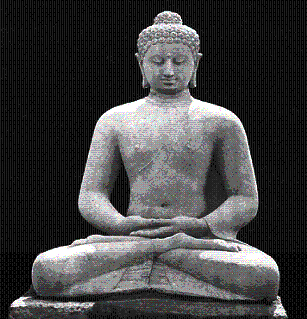
By Herman Hesse
Red and Black Publishers, St Petersburg, Florida
Translated
by Gunther Olesch, Anke Dreher, Amy Coulter, Stefan Langer, Semyon Chaichenets,
2001
From a public
domain etext prepared by Michael Pullen
Library of Congress
Cataloging-in-Publication Data
Hesse,
Hermann, 1877-1962.
[Siddhartha. English]
Siddhartha / by Herman Hesse ; translated by Gunther Olesch ... [et
al.].
p.
cm.
ISBN 978-1-934941-01-0
I. Olesch,
Gunther. II. Title.
PT2617.E85S513 2008
833' .912 -- dc22
2007052257
Red
and Black Publishers, PO Box 7542, St Petersburg, Florida,
33734
Contact
us at: info@RedandBlackPublishers.com
Printed and manufactured in the United States of America
First Part
To
Romain Rolland, my dear friend
The
Son Of The Brahman
In
the shade of the house, in the sunshine of the riverbank near the boats, in the
shade of the Sal-wood forest, in the shade of the fig tree is where Siddhartha
grew up, the handsome son of the Brahman, the young falcon, together with his
friend Govinda, son of a Brahman. The sun tanned his light shoulders by the
banks of the river when bathing, performing the sacred ablutions, the sacred
offerings. In the mango grove, shade poured into his black eyes, when playing as
a boy, when his mother sang, when the sacred offerings were made, when his
father, the scholar, taught him, when the wise men talked. For a long time,
Siddhartha had been partaking in the discussions of the wise men, practising
debate with Govinda, practising with Govinda the art of reflection, the service
of meditation. He already knew how to speak the Om silently, the word of words,
to speak it silently into himself while inhaling, to speak it silently out of
himself while exhaling, with all the concentration of his soul, the forehead
surrounded by the glow of the clear-thinking spirit. He already knew to feel
Atman in the depths of his being, indestructible, one with the universe.
Joy
leapt in his father’s heart for his son who was quick to learn, thirsty for
knowledge; he saw him growing up to become great wise man and priest, a prince
among the Brahmans.
Bliss
leapt in his mother’s breast when she saw him, when she saw him walking, when
she saw him sit down and get up, Siddhartha, strong, handsome, he who was
walking on slender legs, greeting her with perfect respect.
Love
touched the hearts of the Brahmans’ young daughters when Siddhartha walked
through the lanes of the town with the luminous forehead, with the eye of a
king, with his slim hips.
But
more than all the others he was loved by Govinda, his friend, the son of a
Brahman. He loved Siddhartha’s eye and sweet voice, he loved his walk and the
perfect decency of his movements, he loved everything Siddhartha did and said
and what he loved most was his spirit, his transcendent, fiery thoughts, his
ardent will, his high calling. Govinda knew: he would not become a common
Brahman, not a lazy official in charge of offerings; not a greedy merchant with
magic spells; not a vain, vacuous speaker; not a mean, deceitful priest; and
also not a decent, stupid sheep in the herd of the many. No, and he, Govinda, as
well did not want to become one of those, not one of those tens of thousands of
Brahmans. He wanted to follow Siddhartha, the beloved, the splendid. And in days
to come, when Siddhartha would become a god, when he would join the glorious,
then Govinda wanted to follow him as his friend, his companion, his servant, his
spear-carrier, his shadow.
Siddhartha
was thus loved by everyone. He was a source of joy for everybody, he was a
delight for them all.
But
he, Siddhartha, was not a source of joy for himself, he found no delight in
himself. Walking the rosy paths of the fig tree garden, sitting in the bluish
shade of the grove of contemplation, washing his limbs daily in the bath of
repentance, sacrificing in the dim shade of the mango forest, his gestures of
perfect decency, everyone’s love and joy, he still lacked all joy in his
heart. Dreams and restless thoughts came into his mind, flowing from the water
of the river, sparkling from the stars of the night, melting from the beams of
the sun, dreams came to him and a restlessness of the soul, fuming from the
sacrifices, breathing forth from the verses of the Rig-Veda, being infused into
him, drop by drop, from the teachings of the old Brahmans.
Siddhartha
had started to nurse discontent in himself, he had started to feel that the love
of his father and the love of his mother, and also the love of his friend,
Govinda, would not bring him joy for ever and ever, would not nurse him, feed
him, satisfy him. He had started to suspect that his venerable father and his
other teachers, that the wise Brahmans had already revealed to him the most and
best of their wisdom, that they had already filled his expecting vessel with
their richness, and the vessel was not full, the spirit was not content, the
soul was not calm, the heart was not satisfied. The ablutions were good, but
they were water, they did not wash off the sin, they did not heal the spirit’s
thirst, they did not relieve the fear in his heart. The sacrifices and the
invocation of the gods were excellent—but was that all? Did the sacrifices
give a happy fortune? And what about the gods? Was it really Prajapati who had
created the world? Was it not the Atman, He, the only one, the singular one?
Were the gods not creations, created like me and you, subject to time, mortal?
Was it therefore good, was it right, was it meaningful and the highest
occupation to make offerings to the gods? For whom else were offerings to be
made, who else was to be worshipped but Him, the only one, the Atman? And where
was Atman to be found, where did He reside, where did his eternal heart beat,
where else but in one’s own self, in its innermost part, in its indestructible
part, which everyone had in himself? But where, where was this self, this
innermost part, this ultimate part? It was not flesh and bone, it was neither
thought nor consciousness, thus the wisest ones taught. So, where, where was it?
To reach this place, the self, myself, the Atman, there was another way, which
was worthwhile looking for? Alas, and nobody showed this way, nobody knew it,
not the father, and not the teachers and wise men, not the holy sacrificial
songs! They knew everything, the Brahmans and their holy books, they knew
everything, they had taken care of everything and of more than everything, the
creation of the world, the origin of speech, of food, of inhaling, of exhaling,
the arrangement of the senses, the acts of the gods, they knew infinitely
much—but was it valuable to know all of this, not knowing that one and only
thing, the most important thing, the solely important thing?
Surely,
many verses of the holy books, particularly in the Upanishades of Samaveda,
spoke of this innermost and ultimate thing, wonderful verses. “Your soul is
the whole world”, was written there, and it was written that man in his sleep,
in his deep sleep, would meet with his innermost part and would reside in the
Atman. Marvellous wisdom was in these verses, all knowledge of the wisest ones
had been collected here in magic words, pure as honey collected by bees. No, not
to be looked down upon was the tremendous amount of enlightenment which lay here
collected and preserved by innumerable generations of wise Brahmans.—But where
were the Brahmans, where the priests, where the wise men or penitents, who had
succeeded in not just knowing this deepest of all knowledge but also to live it?
Where was the knowledgeable one who wove his spell to bring his familiarity with
the Atman out of the sleep into the state of being awake, into the life, into
every step of the way, into word and deed? Siddhartha knew many venerable
Brahmans, chiefly his father, the pure one, the scholar, the most venerable one.
His father was to be admired, quiet and noble were his manners, pure his life,
wise his words, delicate and noble thoughts lived behind its brow—but even he,
who knew so much, did he live in blissfulness, did he have peace, was he not
also just a searching man, a thirsty man? Did he not, again and again, have to
drink from holy sources, as a thirsty man, from the offerings, from the books,
from the disputes of the Brahmans? Why did he, the irreproachable one, have to
wash off sins every day, strive for a cleansing every day, over and over every
day? Was not Atman in him, did not the pristine source spring from his heart? It
had to be found, the pristine source in one’s own self, it had to be
possessed! Everything else was searching, was a detour, was getting lost.
Thus
were Siddhartha’s thoughts, this was his thirst, this was his suffering.
Often
he spoke to himself from the Chandogya-Upanishad the words: “Truly, the name
of the Brahman is satyam—verily, he who knows such a thing, will enter the
heavenly world every day.” Often, it seemed near, the heavenly world, but
never he had reached it completely, never he had quenched the ultimate thirst.
And among all the wise and wisest men he knew and whose instructions he had
received, among all of them there was no one, who had reached it completely, the
heavenly world, who had quenched it completely, the eternal thirst.
“Govinda,”
Siddhartha spoke to his friend, “Govinda, my dear, come with me under the
Banyan tree, let’s practise meditation.”
They
went to the Banyan tree, they sat down, Siddhartha right here, Govinda twenty
paces away. While putting himself down, ready to speak the Om, Siddhartha
repeated murmuring the verse:
Om
is the bow, the arrow is soul,
The
Brahman is the arrow’s target,
That
one should incessantly hit.
After
the usual time of the exercise in meditation had passed, Govinda rose. The
evening had come, it was time to perform the evening’s ablution. He called
Siddhartha’s name. Siddhartha did not answer. Siddhartha sat there lost in
thought, his eyes were rigidly focused towards a very distant target, the tip of
his tongue was protruding a little between the teeth, he seemed not to breathe.
Thus sat he, wrapped up in contemplation, thinking Om, his soul sent after the
Brahman as an arrow.
Once,
Samanas had travelled through Siddhartha’s town, ascetics on a pilgrimage,
three skinny, withered men, neither old nor young, with dusty and bloody
shoulders, almost naked, scorched by the sun, surrounded by loneliness,
strangers and enemies to the world, strangers and lank jackals in the realm of
humans. Behind them blew a hot scent of quiet passion, of destructive service,
of merciless self-denial.
In
the evening, after the hour of contemplation, Siddhartha spoke to Govinda:
“Early tomorrow morning, my friend, Siddhartha will go to the Samanas. He will
become a Samana.”
Govinda
turned pale, when he heard these words and read the decision in the motionless
face of his friend, unstoppable like the arrow shot from the bow. Soon and with
the first glance, Govinda realized: Now it is beginning, now Siddhartha is
taking his own way, now his fate is beginning to sprout, and with his, my own.
And he turned pale like a dry banana-skin.
“O
Siddhartha,” he exclaimed, “will your father permit you to do that?”
Siddhartha
looked over as if he was just waking up. Arrow-fast he read in Govinda´s soul,
read the fear, read the submission.
“O
Govinda,” he spoke quietly, “let’s not waste words. Tomorrow, at daybreak
I will begin the life of the Samanas. Speak no more of it.”
Siddhartha
entered the chamber, where his father was sitting on a mat of bast, and stepped
behind his father and remained standing there, until his father felt that
someone was standing behind him. Quoth the Brahman: “Is that you, Siddhartha?
Then say what you came to say.”
Quoth
Siddhartha: “With your permission, my father. I came to tell you that it is my
longing to leave your house tomorrow and go to the ascetics. My desire is to
become a Samana. May my father not oppose this.”
The
Brahman fell silent, and remained silent for so long that the stars in the small
window wandered and changed their relative positions, ‘ere the silence was
broken. Silent and motionless stood the son with his arms folded, silent and
motionless sat the father on the mat, and the stars traced their paths in the
sky. Then spoke the father: “Not proper it is for a Brahman to speak harsh and
angry words. But indignation is in my heart. I wish not to hear this request for
a second time from your mouth.”
Slowly,
the Brahman rose; Siddhartha stood silently, his arms folded.
“What
are you waiting for?” asked the father.
Quoth
Siddhartha: “You know what.”
Indignant,
the father left the chamber; indignant, he went to his bed and lay down.
After
an hour, since no sleep had come over his eyes, the Brahman stood up, paced to
and fro, and left the house. Through the small window of the chamber he looked
back inside, and there he saw Siddhartha standing, his arms folded, not moving
from his spot. Pale shimmered his bright robe. With anxiety in his heart, the
father returned to his bed.
After
another hour, since no sleep had come over his eyes, the Brahman stood up again,
paced to and fro, walked out of the house and saw that the moon had risen.
Through the window of the chamber he looked back inside; there stood Siddhartha,
not moving from his spot, his arms folded, moonlight reflecting from his bare
shins. With worry in his heart, the father went back to bed.
And
he came back after an hour, he came back after two hours, looked through the
small window, saw Siddhartha standing, in the moon light, by the light of the
stars, in the darkness. And he came back hour after hour, silently, he looked
into the chamber, saw him standing in the same place, filled his heart with
anger, filled his heart with unrest, filled his heart with anguish, filled it
with sadness.
And
in the night’s last hour, before the day began, he returned, stepped into the
room, saw the young man standing there, who seemed tall and like a stranger to
him.
“Siddhartha,”
he spoke, “what are you waiting for?”
“You
know what.”
“Will
you always stand that way and wait, until it’ll becomes morning, noon, and
evening?”
“I
will stand and wait.
“You
will become tired, Siddhartha.”
“I
will become tired.”
“You
will fall asleep, Siddhartha.”
“I
will not fall asleep.”
“You
will die, Siddhartha.”
“I
will die.”
“And
would you rather die, than obey your father?”
“Siddhartha
has always obeyed his father.”
“So
will you abandon your plan?”
“Siddhartha
will do what his father will tell him to do.”
The
first light of day shone into the room. The Brahman saw that Siddhartha was
trembling softly in his knees. In Siddhartha’s face he saw no trembling, his
eyes were fixed on a distant spot. Then his father realized that even now
Siddhartha no longer dwelt with him in his home, that he had already left him.
The
Father touched Siddhartha’s shoulder.
“You
will,” he spoke, “go into the forest and be a Samana. When you’ll have
found blissfulness in the forest, then come back and teach me to be blissful. If
you’ll find disappointment, then return and let us once again make offerings
to the gods together. Go now and kiss your mother, tell her where you are going
to. But for me it is time to go to the river and to perform the first
ablution.”
He
took his hand from the shoulder of his son and went outside. Siddhartha wavered
to the side, as he tried to walk. He put his limbs back under control, bowed to
his father, and went to his mother to do as his father had said.
As
he slowly left on stiff legs in the first light of day the still quiet town, a
shadow rose near the last hut, who had crouched there, and joined the pilgrim—Govinda.
“You
have come,” said Siddhartha and smiled.
“I
have come,” said Govinda.